
Jesus’ Early Childhood in Egypt: Lessons from Joseph

Dreams of Egypt
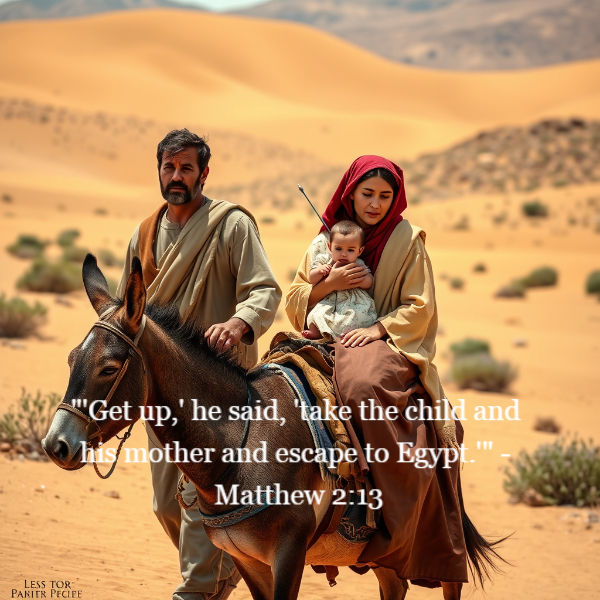
Did you know that Jesus spent part of His early childhood in Egypt? After the Wise Men returned to their country, Joseph, Jesus' earthly father, had a dream. In the dream, an angel told Joseph to take the child to Egypt to escape King Herod's wrath. Herod the Great vowed to kill every male child in Bethlehem under the age of two to prevent the child the Wise Men called “king of the Jews” from ever reigning (Matthew 2:16-18).
Why Egypt? The Prophetic Meaning of Hosea 11:1
But why Egypt? Egypt is important because Hosea 11:1 tells us, "Out of Egypt have I called my son." Hosea is describing the exodus of the Jews from Egypt to the promised land. God often referred to Israel as His son. But this is not just a statement of fact; this is a statement with a deeper significance. God's own Son would also go down to Egypt and then return to the Promised Land.
Parallels with the Exodus: Jesus as the New Israel
In Egypt, He would find refuge and become the new Moses delivering His people from the bondage of slavery to sin. He is the ultimate deliverer. Jesus is the new Israel, perfectly fulfilling the destiny that God originally intended for His people. We see parallels in the Old Testament in several areas.
Just as Moses was hidden in a basket to escape pharaoh's wrath, so Jesus was hidden away in Egypt in a place of safety. To leave Egypt the Israelites had to pass through the Red Sea where 1 Corinthians 10:2 tells us they were "baptized." When Jesus returned from Egypt, one of His first public acts was to be baptized in the Jordan River. In effect, Jesus also passed through the waters.
The Israelites passed through the Red Sea, but then wandered forty years in the desert, failing their test of faith. After Jesus' baptism, He endured 40 days in the desert where Satan tempted Him. There, He never wavered from His Father's will.
Each of these moments reveals Jesus stepping into Israel’s story, not as a repeat, but as its true fulfillment.
Jesus’ Perfect Fulfillment of Israel’s Destiny
The parallels we just read about matter because Jesus perfectly fulfilled what should have been the destiny of Israel. He was and is the perfect Son, able to free us from sin and show us the way to a righteous life. Because Israel could never be perfect, Jesus came to offer Himself as a sinless sacrifice offering reconciliation with God. Jesus offers us a deeper union with God than had been available to the Old Testament saints because we have a better covenant and fuller access to God (Hebrews 8:10-12). Joseph's obedience to God teaches us some important lessons.
Joseph’s Obedience: Trusting God in Action
Fleeing to Egypt was God's chosen means of protecting His Son from harm by Herod. Joseph trusted in God's sovereign protection of his family. Joseph loved his family and his newborn Son. He never questioned, "Why Egypt?" Instead, he not only listened to the warning but he acted on it. He didn't wait several days trying to decide if he should go or not. He didn't worry about all of the unknowns. He simply obeyed.
When we hear God clearly speaking to us do we act or do we waver? Do we really believe He will be faithful to us?
When the angel appeared to Joseph in his dream (Matthew 2:13) his message was urgent. "Get up!" The angel told him to flee to Egypt but the instructions didn't stop there. The angel said to stay there until he told Joseph to return to Israel. Scholars believe the family stayed in Egypt for 3-4 years. Joseph had to trust in God's timing. He had to be patient, waiting on God can be difficult. Many of us have trouble doing that.
We often have moments when we feel God calling us to step into the unknown, perhaps a career change, a move, or a difficult family decision. In those situations, it’s tempting to hesitate, to demand all the answers first. Joseph didn’t have that luxury. Like Joseph we can trust God's plan for our families.
The angel explained to Joseph that Herod would search for Jesus to kill Him. What must Joseph have thought? Did he wonder, or perhaps already know, that Jesus was the Messiah? Joseph seems to have been a man willing to follow God's instructions step by step. He accepted responsibility for His Son's safety without knowing what that obedience would ultimately cost. He was open to hearing God.
Following Herod's death, Joseph brought his family back to Israel as instructed by an angel in a dream. This was the fourth time Joseph had received an angelic message from God. Joseph feared Herod's son, Archelaus, who had come to power in Judea. He was infamous for his cruelty.
So Joseph took his family to Galilee, choosing to settle in the town of Nazareth. The difficult journey, from Egypt to Nazareth, was approximately 300 miles and would have taken weeks or even months. This small detail was also a fulfillment of prophecy found in several places in the Old Testament. The return from Egypt did not bring immediate safety; instead, it required careful discernment as God continued to guide Joseph step by step.
"Did we but look upon the world as our Egypt, the place of our bondage and banishment, and heaven only as our Canaan, our home, our rest, we should as readily arise and depart thither, when we are called for, as Joseph did out of Egypt." - Matthew Henry's Concise Commentary
Nazareth: Geography, Culture, and Prophecy
Where was Nazareth and why does it matter? Nazareth was north of Bethlehem in Judea almost 94 miles (151 km). The region of Samaria lay in between. Although this may seem like an unimportant lesson in geography, the people of Galilee were very different from those of Judea where the capital of Jerusalem was.
Judea and Samaria were Roman prefects, while Galilee had a separate prince during Jesus' life, Herod Antipas—the same Herod who later killed John the Baptist and questioned Jesus. This political and cultural environment will become important when we see Jesus confronting religious leaders later in His life in Judea.
Prophetically, Nazareth was an important place. Isaiah 11:1 speaks of a “branch” (netzer) growing from the cut-down line of Jesse, King David's father. Isaiah explains that the Messiah will come from the “stump of Jesse” because David’s royal line had long lost its throne and glory, yet God promised to raise a righteous King from what appeared dead. Both Mary and Joseph traced their family history back to King David.
While no Old Testament verse names Nazareth directly, Jesus being raised there fits this prophetic pattern. Nazareth was obscure, overlooked, and even despised, reflecting the way the prophets said the Messiah would come; humble and rejected, yet chosen by God (Isaiah 53; Psalm 22).
People rejected Jesus not just for His words, but for where He was from, His accent, and the regional differences He represented. Have you ever experienced rejection or persecution because of where you were from?
Culturally, they spoke with a different dialect, were considered much less sophisticated and were often believed to be less faithful to Jewish customs. When Jesus reproached the Jewish leaders in Jerusalem, their assumptions about Him were already shaping their response. As Nathanael says in John 1:46, "Can anything good come out of Nazareth?" That cultural divide helps us understand the social tension Jesus faced.
It would be like a rural preacher from the southern United States confronting a mega church pastor in Los Angeles. Before Jesus spoke a word, the tension would have already existed.
Understanding the significance of Nazareth helps us see that Jesus’ life unfolded in ways God has always worked; through humility and the insignificant things of the world. Just as Nazareth was an unexpected place to raise the Messiah, Egypt was an unexpected place to protect Him.
Echoes of the Old Testament in Jesus’ Early Childhood in Egypt
Joseph and his family fleeing to Egypt echoes Old Testament events. We see this many times in the Bible. For instance, just as the blood of the Passover lamb protected God’s people in Egypt, God preserved His Son in Egypt, foreshadowing the ultimate sacrifice Jesus would make for our salvation. Christ is our Passover.
These echoed events help us see that Jesus is the complete fulfillment of the Old Testament. Surprising as it was, Jesus' early childhood in Egypt, a mostly gentile nation, foreshadowed His salvation for the whole world, not just the Jews. He was the perfect sinless sacrifice who returned from Egypt to free us from our captivity to sin. In this He did not fail! Thanks be to God! Even today the story of Joseph taking his family to Egypt for safety is celebrated.
Refuge in Egypt Then and Now
The refuge Egypt offered is recognized in modern times in the Coptic Christian Church in Egypt. They celebrate the "Feast of the Entry of the Lord in Egypt" on June 1st, celebrating the holy family's escape as refugees from Herod. They consider it a great blessing and believe that their arrival helped prepare Egypt to welcome Christianity.
Symbolically, the Egyptian church believes we should all flee evil and find refuge in Jesus. Sadly, the church in Egypt is under intense persecution. The Coptic Church today runs to Jesus for safe harbor, as He ran to Egypt as a young child.
In Joseph, we see a man who listens to God and obeys. In doing so, he loved and protected his family from danger, fulfilled prophecy, and gave us an example of humility and service. When we listen to God, we will know when and how to flee sin and danger. We will trust that in Him we have a safe harbor, just as He had as a baby in Egypt.


Comments