
Joseph and Judah in Genesis: Foreshadowing Jesus as Savior and King

Why Reading the Old Testament Matters
In my experience, people often avoid reading the Old Testament. It is worth remembering that when Jesus and His disciples talk about Scripture, it is the Old Testament they are referring to. Many stories or prophecies mentioned in the Old Testament have what is known as a dual fulfillment. This simply means they often have a short-term and a long-term fulfillment. The stories surrounding Joseph and Judah offer a beautiful example, foreshadowing Jesus as Savior and King. I want to begin by highlighting one such story that you may be familiar with, found in Genesis 37:9-11.
Joseph’s Prophetic Dreams and Their Short-Term Fulfillment
Here Joseph is explaining the second of two dreams he had, which foretold a time when his brothers and others would bow down to him.
"Then he dreamed still another dream and told it to his brothers, and said, “Look, I have dreamed another dream. And this time, the sun, the moon, and the eleven stars bowed down to me." Genesis 37:9
When Joseph's father Jacob and his eleven brothers heard this, they immediately interpreted it to mean that one day they would be under the authority of Joseph. You can imagine if you told your brothers that they would one day bow down to you, how well that would go over! This only increased the hostility that Joseph's brothers had toward him, contributing to their decision to be rid of him by selling him into slavery.
From Trials to Triumph: Joseph as a Type of Christ
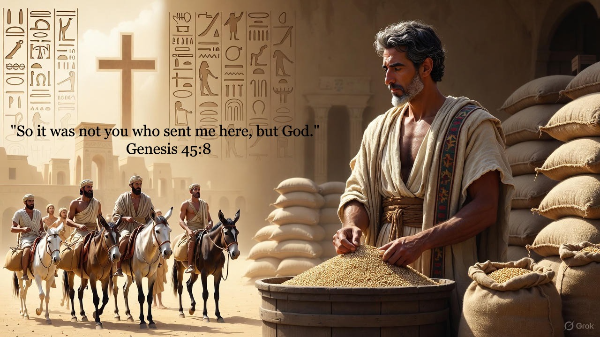
As many of you know, Joseph's life shows us God's plan in suffering and his eventual rise to become the "right hand man" of the Egyptian pharaoh. As such, he instructs the Egyptians to store grain for a famine he knows is coming because of another prophetic dream he had. In time, his brothers come to Egypt for food and do indeed find themselves bowing before their brother, whom they do not recognize. Through this, the nation of Israel was saved, the line of David was assured, and the birth of the Messiah would eventually happen.
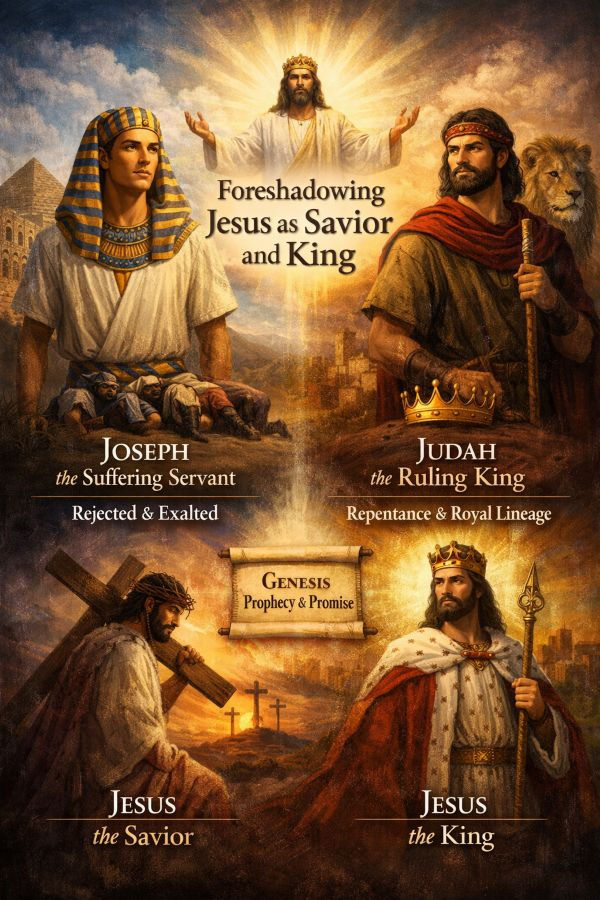
This is an example of a short-term fulfillment. But there is so much more to this prophetic dream. Joseph himself becomes a foreshadowing of Jesus. His life of hardship: rejected by his own people, sold for silver, falsely imprisoned, elevated to a position of power, and forgiving and saving his people, mirrors Jesus on an earthly scale. Looking further into the future, we see an even longer-term fulfillment as the story continues. First in Jesus born in first-century Israel, and later in Jesus as the reigning King of the New Jerusalem yet to come.
Judah: From Failure to Royal Lineage
Joseph’s life echoes Christ's. But suffering is not the final word. Later in Genesis, Jacob’s blessing of Judah shifts our attention from the suffering servant to the coming King. It is from Judah's lineage that Christ will be born, for He is the Lion of the Tribe of Judah. Joseph reminds us of Jesus as the suffering servant, while Judah is the ruling king. In these stories we see both sides of Jesus displayed and both, in their way, pointing to a future fulfillment.
In Genesis 49:8, as Jacob lay dying, he blesses each of his sons. To Judah, whose name means 'praise', he says these words,
"Judah, you are he whom your brothers shall praise; Your hand shall be on the neck of your enemies; Your father’s children shall bow down before you."
The Fulfillment of God’s Promises Through Joseph and Judah
Judah's blessing indicates that the tribe of Judah would be important in the future of the Jewish nation. Indeed, Judah became the most prominent of all the tribes producing kings like David and Solomon. The expression, "Your hand on the neck of your enemies," simply means that Judah and his offspring will be victorious over their enemies.
We see this in the military success of King David, as well as the future victory of Christ over sin and death. In 2 Samuel 5:1-3 we are told that all of the tribes of Israel paid homage to King David. And one day, every knee shall bow and tongue confess that Jesus Christ is Lord (Philippians 2:10-11).
Jacob describes Judah as a lion's cub (Genesis 49:9) and in Revelation 5:5, John calls the victorious Jesus, the Lion of the Tribe of Judah. Jacob compares Judah to a protective lioness and asks, "Who dares to rouse him?" What nation would be bold enough to rouse this lion into action? We know when the nations of the earth are roused against Israel one last time at the Battle of Armageddon, they are completely and utterly destroyed.
In Genesis 49:10, Jacob says the scepter will remain with Judah until "Shiloh" comes, a reference to the Messiah. The scepter is a sign of ruling authority. All believers must accept the authority of Christ forever. The lineage of Judah will remain forever at the coming of Jesus. Genesis 49:11 continues this imagery showing the complete abundance that people will experience during the reign of the Messiah (Revelation 20:4).
Judah as a Substitute: A Foreshadowing of Christ
Why was Judah chosen for such a blessing? Judah was actually the brother who first suggested that they sell Joseph into slavery. But by the time the brothers arrive in Egypt and discover their brother Joseph in charge of everything, he displays a change of heart. In Genesis 44 we see Judah offering to become a slave in exchange for his younger brother Benjamin.
Why did he do this? Judah had guaranteed his father that he would bring his youngest son home safely. In Christ, we have a guarantee of Heaven if we have faith and believe. Out of love for his father who could not bear to lose his youngest child, Judah offered himself as a substitute. Judah even told his father if he did not bring Benjamin back, he "would bear the blame forever." Jesus took the blame on our behalf. This foreshadows the sacrifice of Christ for us on the cross.
The Faithfulness of God Across Generations
What makes this story even more meaningful is that Joseph was a good guy from beginning to end. He always remained faithful to God. But Judah on the other hand, made many terrible mistakes. After impregnating his dead son's wife, his life and his heart changed. No one would be surprised if Joseph had been chosen to be the forefather of the Messiah, but Judah? Like Judah, we can also be redeemed and turn our own lives around because of Jesus.
Foreshadowing Jesus as Savior and King
Joseph was blessed to preserve the family which would become Israel, while Judah was chosen for the royal Messianic line despite his previous failures—one pointing to Jesus the Savior, and the other to Jesus the conquering King. God is always faithful to His promises. God's covenant promises to Abraham were fulfilled thanks to Joseph. Joseph's brothers did bow down to him as he had been shown in his dream.
Jacob's prophecy that the scepter would not depart from Judah was also fulfilled when his descendant, King David, established a royal line that would never end (2 Samuel 7). Judah was promised the obedience of all the people. This promise will be fulfilled during the Messiah's reign on earth and this will be the New Jerusalem's hope.
Old Testament Stories Pointing to Christ
Throughout the Old Testament we see examples of "types of Christ." From Joseph, to Judah, and David, to Solomon, these stories purposely lead us toward the expectation and fulfillment of Christ as Messiah. We should be able to say with Paul,
"Oh, the depth of the riches both of the wisdom and knowledge of God! How unsearchable are His judgments and His ways past finding out!" Romans 11:33
This is precisely why studying the Old Testament is so important. Stories with dual fulfillment help us see the richness of Old Testament history on a grand scale, always pointing to the future. They are foreshadowing Jesus as Savior and King, first as Christ, our suffering servant who takes away our sin, and finally as our great King to whom the whole world bows. All praise to God our King!
In the words of Jesus,
“You search the Scriptures…and it is they that bear witness about me.” John 5:39
Questions You May Have:
What is foreshadowing? Foreshadowing is a writing device that hints at things to come.


Comments